Friday, February 10, 2012

Should Christians remain friends with sinners?

First I must apologize for my inconsistent posting this week. I am preaching on Sunday and because I don't preach every week I am having a hard time finding the balance between sermon prep and blog writing. It is not that I haven't had the time to blog. The difficulty is separating the blogging from the sermon prep. I was fighting the urge to blog my sermon all week which would not have been good for a number of reasons. (I should be posting a video of my sermon next week.) I think that once I start serving full-time in a church and get into a routine that it won't be an issue.

On to the post.

I came across an interesting article this week from Alan Shlemon of Stand To Reason. He tackles the very thorny and controversial topic of how Christians should relate to Homosexuals. Specifically he looks at the question of whether or not Christians–specifically those that think homosexuality is a sin–should have friends that are homosexual:

"Part of the problem stems from the belief that if you keep your convictions about homosexuality, then you can’t stay in relationship with your friends and family who say they’re gay."

Shlemon notes that this is just not the Biblical way of looking at this issue:

"The New Testament doesn’t prohibit Christians from friending (I know, I know…that’s so Facebook-ish) homosexuals. Paul, writing about a sexually immoral man in 1 Corinthians 5:9-10, tells Christians that they are “not to associate with sexually immoral people— not at all meaning the people of this world who are immoral, or the greedy and swindlers, or idolaters. In that case you would have to leave this world.” Notice how Paul clarifies that we don’t have to avoid relationships with non-believers (who he calls “people of this world”). After all, we can’t influence them if we’re not involved at all."

The idea that you end a relationship with someone because they are living a life that is contrary to what the Bible teaches also goes against the way that Jesus lived his life. Part of the charge that the Pharisees made against Jesus was that he associated with "tax collectors and sinners." This doesn't mean that Jesus approved of their behavior or encouraged them to continue in it. Quite the opposite. Jesus commanded people to stop sinning. It is also good to remember that Jesus tended to be harder on the religious zealots for being hypocritical than he was on the sinner. We have to balance being true to our convictions and not being a jerk.

Mr. Shlemon goes on to explain what Paul was saying in 1 Corinthians 5:9-10:

"There is a group of people that Paul warns Christians to avoid. Continuing his discussion on sexual immorality in 1 Corinthians 5:11, Paul explains, “But now I am writing to you not to associate with anyone who bears the name of a brother if he is guilty of sexual immorality or greed, or is an idolater, reviler, drunkard, or swindler—not even to eat with such a one.” The people Paul warns us to avoid are Christians who engage in sexual immorality. Why? Because sin left unchecked within a body of believers is like cancer. It spreads and harms those around them (1 Corinthians 5:6-7).

"That doesn’t mean we are to end all relationships with Christians who have committed sexual sin. Paul is talking about unrepentant Christians. People who know the biblical standard but thumb their nose at it and continue in the illicit behavior. That’s the context of 1 Corinthians 5."

What is also included in that list of people are those that are guilty of greed, idolatry, revilers, drunks, or swindlers. Paul is telling us to avoid Christians that are willfully living disobedient lives. As Mr. Shlemon points out, these attitudes can erode our own sense of right and wrong.

Mr. Shlemon concludes by saying:

"In all other circumstances, there’s no reason to choose between your faith and your friends. Keep them both so you have a chance to be a positive influence in your relationships. That’s the point of being an ambassador for Christ."

Wednesday, February 08, 2012

Religious Freedom Revisited

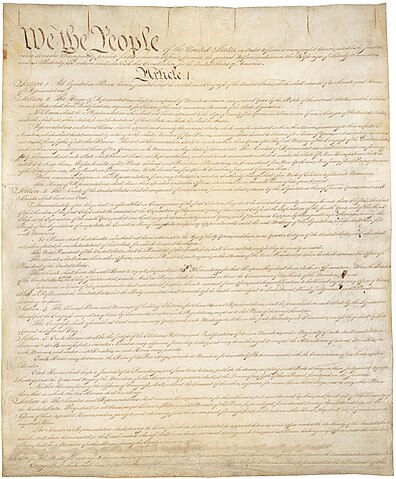
U.S. Constitution

Last month I shared an article about the ruling in the Hosanna-Tabor v. EEOC case that was before the United States Supreme Court. In that particular case the Supreme Court ruled that a church had the freedom to fire an unwanted minister even if it was only for religious reasons. Those reasons are usually not valid reasons to be fired for a job but the Court realized that there is an exemption from those rules when it came to ministers in a church.

Justice Roberts wrote:

"We agree that there is such a ministerial exception. Requiring a church to accept or retain an unwanted minister, or punishing a church for failing to do so, intrudes upon more than a mere employment decision. Such action interferes with the internal governance of the church, depriving the church of control over the selection of those who will personify its beliefs."

It may seem like a very cut and dry situation but it seems that some college campuses do not think so when it comes to group membership and so far the Supreme Court has agreed. In the last two weeks the State University of New York at Buffalo and Vanderbilt University (ironically founded as a Methodist school) have told on campus Christian organizations that they cannot require their leaders to hold to their statement of faith. According to a World Magazine article:

"The student-led governing board (at SUNY Buffalo) put InterVarsity on suspension in December, after someone complained that one of the group's leaders felt pressured to resign his position because he was gay. Senate members voted to lift the suspension temporarily so that the group could meet to revise its constitution, approving at the same time a new fiscal suspension that prevents InterVarsity from spending any of its $6,000 student activity fee budget.

"A lawyer advising the Senate told the students that InterVarsity could not, under the U.S. Constitution, require its leaders to agree to any statement of faith or beliefs. But the most recent U.S. Supreme Court decision on campus religious groups - CLS v. Martinez - only forbade statement of faith requirements if a school had an "all-comers" policy, which would require all groups to be open to all people."

The Supreme Court has ruled that if a school has an "all-comers" policy then no requirements can be placed upon any group. It seems a bit hypocritical to allow churches to have a religious belief exemption when it came to who they hired and fired but not allowing campus ministry groups to do the same. But there are deeper ramifications for these types of policies. They cut both ways as a wnd.com article points out:

"Now a similar rule is being implemented on the campus of Vanderbilt University. But this time a Christian professor is pointing out that under the same rule, Christians would be allowed to join an organization of atheists or Muslims and exert influence.

"(Carol) Swain (Professor of Political Law at Vanderbilt) said that the university has put itself in an awkward position. If officials say that Christians cannot join an LGBT or Muslim group they will be in violation of their own policy. But allowing Christians to join these groups means they can effect change in their agendas."

But so far Vanderbilt has not put it's policy in writing and has even been contradictory as to what the policy is going to include:

"According to Justin Gunther, president of Christian Legal Society at Vanderbilt, a member of the administration said in public that if members of a Christian group were to use religious motivation as a basis for not voting for an officer, it would be in violation of the university’s policy.

"The statement contradicted statements made that evening by (Provost Richard) McCarty who said members could use any criteria they wanted when voting, as long as everyone was given an opportunity to run for the position."

What will be interesting is to see how these rules by the various universities look in their final form. There will undoubtedly be some legal ramifications as well. But the most telling aspect of this is Vanderbilt Provost McCarty's statement that faith views should not be imposed upon others. Of course that rule doesn't apply to the University or it's Provost. They are free to impose their faith views however they see fit.

Monday, February 06, 2012

An Eternal Grace

 A friend of mine sent me a devotional last week. It is based on 1 Chronicles 4:22 which says:

"and Jokim, and the men of Cozeba, and Joash, and Saraph, who ruled in Moab and returned to Lehem (now the records are ancient)."

The first 9 chapters of 1 Chronicles are lists of geneologies. The author took the time to trace them out and in the middle of it all adds the comment that "the records are ancient." Which is a very interesting thing to say as you are going through ancient records. That is where the devotional comes in:

"But not so ancient as those precious things that are the delight of our souls. Let us for a moment recount them, repeating them as misers count their gold. The sovereign choice of the Father, by which He elected us unto eternal life, before creation, is a matter of vast antiquity, since no date can be conceived for it by the mind of man. We were chosen from before the foundations of the world.

"Everlasting love went with the choice, for it was not a bare act of divine will by which we were set apart, but the divine affections were concerned. The Father loved us in and from the beginning. Here is a theme for daily contemplation. The eternal purpose to redeem us from our foreseen ruin, to cleanse and sanctify us and at last to glorify us, was of infinite antiquity and runs side by side with immutable love and absolute sovereignty.

"The covenant is always described as being everlasting, and Jesus, the second party in it, is from eternity. He struck hands in sacred covenant long before the first stars began to shine, and it was in Him that the elect were ordained unto eternal life. In this way a most blessed covenant union was established between the Son of God and His elect people, which will remain as the foundation of their safety when time shall be no more.

"Is it not profitable to be conversant with these ancient things? Is it not shameful that they should be so readily neglected and even rejected by the majority of professing Christians? If they knew more of their own sin, would they not be more ready to adore distinguishing grace? Let us both admire and adore tonight, as we sing--

"A monument of grace,
A sinner saved by blood;
The streams of love I trace
Up to the Fountain, God;
And in His sacred bosom see
Eternal thoughts of Love to me."

In the ultimate act of grace, God created us knowing just how sinful we would be. He knew that we would reject him and he created us anyway. That act of grace is just as eternal as God himself. It is a staggering thought and one that is worthy of our praise.

Saturday, February 04, 2012

An Irresponsible Use of Scripture

Without getting too bogged down in the politics of the matter, I found this video taking President Obama to task over his Biblical exegesis to be very good. We can run into all sorts of problems when we take verses out of their context. And I think that what President Obama is advocating is exactly the opposite of what this verse is saying.


I want to step aside from the debate of what the church is supposed to be doing in the world for a minute. It is a very worthwhile debate to have but just outside of the scope of the application of this particular passage. The President is quoting Luke 12:48 which is a part of the passage of Luke 12:35-48. The passage is not about what we are supposed to be doing as the church rather it is talking about the way that we are supposed to be doing it. The passage is a warning to us about taking the easy way out. We are supposed to be working hard doing the things that we are supposed to be doing as the church. I would argue that passing any of our duties off to the government would be taking the easy way out and is exactly the type of thing that this passage is warning against. So if one wants to argue that taking care of the poor is a part of the duty of the church passing the buck (literally or figuratively) to an organization that is very inefficient at doing so is probably not what this passage is telling us to do.

I do find it interesting that President Obama didn't quote Matthew 25:29 which comes at the end of the Parable of the Talents which is all about how we use our resources:

"For to everyone who has will more be given, and he will have an abundance. But from the one who has not, even what he has will be taken away."

But of course that verse wouldn't be making the political point that President Obama was trying to make.


Scripture quotations are from The Holy Bible, English Standard Version® (ESV®), copyright © 2001 by Crossway, a publishing ministry of Good News Publishers. Used by permission. All rights reserved.

Thursday, February 02, 2012

The Jericho Road

The long and winding Jericho Road connects Jerusalem to Jericho. My pastor had the chance to walk that road during his trip to Israel this past fall. He has been sharing the pictures and stories from that trip during our Wednesday night Bible Study and it has been fascinating to read corresponding Bible stories. Often those pictures have given me a whole new appreciation for the stories. The pictures of the Jericho Road last night were no exception in how the illuminated the story of the Good Samaritan found in Luke 10:25-36

The photo on the right shows the Jericho Road. You can see the road right in the middle of the picture. See...it is right there...that small little path that is winding around the cliffs... It is narrow and has cliffs towering above it on the right and cliffs dropping off to the left. It isn't anything like the wide paved roads that we have in the Chicago area. (I use the term paved loosely. Have you seen the potholes?) The distance between Jericho and Jerusalem is about the same distance between my house and downtown Chicago. If I were to drive that trip I would likely take I-55 which we here call the Stevenson. As far as modern expressways go it isn't all that great and is often in need of repair. But it is enormous compared to the Jericho Road.

I-55 in Chicago

 It would be very easy to travel down the Stevenson and not notice someone on the far side of the road. You could honestly pass someone by and not see them. Not so much on the Jericho road. There is no way that you could travel down the road and honestly miss seeing an injured person on the side of the road.

"A man was going down from Jerusalem to Jericho, and he fell among robbers, who stripped him and beat him and departed, leaving him half dead. Now by chance a priest was going down that road, and when he saw him he passed by on the other side. So likewise a Levite, when he came to the place and saw him, passed by on the other side."

There is no way that the priest or the Levite could have missed the injured man. The point that Jesus was making was that they obviously went around. It is something that I knew was a part of the story. But my perception of what a road looks like is very different than what the Jericho Road really is like. It really drives home how intentional I can be when I decide to ignore someone. While I might be able to fool myself, I cannot fool God. There is no claiming honest ignorance. God sees right through that and it is good for me to have a very different picture of the intentional actions of the priest and the Levite. Now I just need to make sure I have the same picture in mind when I think about ignoring someone. 


Jericho Road picture courtesy Rev. Christopher Poest

Scripture quotations are from The Holy Bible, English Standard Version® (ESV®), copyright © 2001 by Crossway, a publishing ministry of Good News Publishers. Used by permission. All rights reserved.


Wednesday, February 01, 2012

Is your pastor preaching sound doctrine?

Burning Fire

The importance of having a sound understanding of Christian doctrine–our particular set beliefs–is one of my great burning passions. And I bet that most Christians, if asked, would agree that properly understanding and conveying what the Bible teaches on a particular topic is important. I am sure that most Christians would also affirm that solid Biblical preaching is an essential part of a pastor's job. That leads to a couple of closely related questions.

  • What process does your pastor use to prepare his Sunday morning sermon?
  • What process does your pastor use to maintain proper Christian doctrine?

I bring this up because a couple of the blogs that I follow wrote about a controversy involving James MacDonald and T.D. Jakes. To be honest I don't want to dwell on it too much because I really haven't been following all of the "Elephant Room" chatter. But the headline of one article caught my eye: How the Elephant Room is Redefining the Pastoral Office.

Tim Raymond's main point in the article is that the inclusion of T.D. Jakes–who is considered by some to fall outside of what has historically been accepted as proper Christian teaching–weakens the perception that sound and proper doctrine is an important part of pastoral ministry. Raymond says:

"And for the pastor, thinking that sound doctrine is insignificant is simply not an option...One of the prerequisites to the pastoral office is that a man be able to teach sound doctrine (1 Timothy 3:2; Titus 1:5-9). Part of the basic job description of the pastor is to proclaim sound doctrine and refute error (Titus 1:9). Pastors are charged to train up their entire congregation in sound doctrine (1 Timothy 4:13-16; Titus 2:1). Pastors are to preach the Word in season and out since the time is coming when those who do not tolerate sound doctrine will infiltrate the church (2 Timothy 4:1-4 [parallelism indicates that preaching the Word is preaching sound doctrine]; cf. Acts 20:28ff.). And the Lord’s stamp of approval on a man’s ministry is partially measured by his commitment to sound doctrine (1 Timothy 4:6)."

So how do we know whether or not our pastors are teaching sound doctrine?

Through a lot of hard work. Acts 17:10-11 says:

"The brothers immediately sent Paul and Silas away by night to Berea, and when they arrived they went into the Jewish synagogue. Now these Jews were more noble than those in Thessalonica; they received the word with all eagerness, examining the Scriptures daily to see if these things were so."

We cannot simply be content to listen to a sermon–that is the easy way which can lead us down the dangerous path of false teaching. We must be like those in Berea and take the time to carefully search the scriptures to make sure that what is being taught is true. I think that it is also important for us to have an understanding of our pastor's process of developing a sermon and how they actively work to stay doctrinally sound. It is important for two reasons. The first is so that we can be sure that our pastor has a way of remaining true to the Word of God. 

I understand that there will be some pastors that find this suggestion to be a bit too intrusive. They may feel like they are being unfairly watched or critiqued. They may feel like it is an added burden to an already heavy work load. They may feel like their process is a bit to lax to really share with anyone. But it is my contention that if someone is truly dedicated to sound doctrine that they should be willing to share and teach their method to others. Which leads me to the second and most important reason that we should take the time to learn our pastor's ways. We should do this so that we have a way of being doctrinally sound. Even if you are someone that already has a good method we should never stop learning. Being able to incorporate parts of someone's process will only make our own process better. And the results will be of a great benefit to the church.


Scripture quotations are from The Holy Bible, English Standard Version® (ESV®), copyright © 2001 by Crossway, a publishing ministry of Good News Publishers. Used by permission. All rights reserved.